
No-Code LSAT Prep Business Ideas: 23,900 Growth Index Points Point to a Vertical Workflow Gap
MNB Citation Block: MicroNicheBrowser has score locked total niches in the current database snapshot: 1,221 launched or validated opportunities, 1,517 rejected ideas, 312,476 evidence rows, and 715 published posts. Today's no-code signal is
Lsat prep resources, with 2,400 monthly search volume, 23,900 growth index, and difficulty currently not populated in the MNB snapshot.
Introduction
LSAC reported that early 2026 law school applicants were up 33% and applications were up 27% versus the same point in the prior cycle, with August, September, and October LSAT administrations each posting double-digit testing growth. That is not a generic edtech signal. It is a timing window for no-code operators who can package narrow workflow software around LSAT prep, admissions planning, tutor operations, and outcome tracking before larger platforms notice the spike.
The broader no-code category is already big enough to support specialized builders. Gartner projects the low-code development technologies market will reach $58.2 billion by 2029, while Zapier reported that 70% of new applications developed by organizations would use no-code or low-code tools by 2025. The useful opportunity is not another course marketplace. It is a narrower operating system for one buyer with one repeated job.
For the broader Friday cluster, see MicroNicheBrowser's earlier analysis on no-code business ideas with surging vertical demand. This post argues that LSAT prep is the strongest no-code wedge this week because demand is measurable, buyer urgency is seasonal, and the work is structured enough for a small operator to ship with Airtable, Softr, Zapier, Make, Stripe, and a thin AI layer.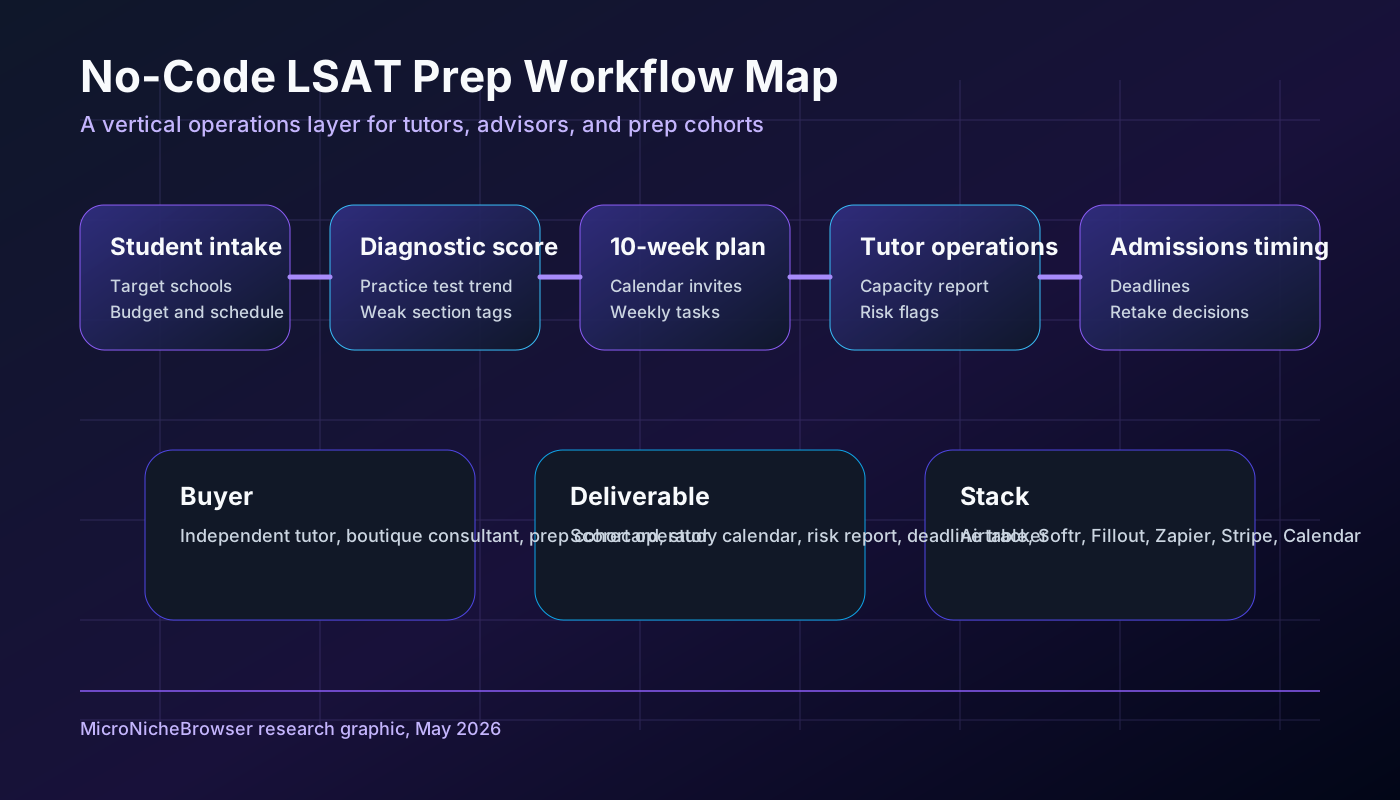
The Market Signal: LSAT Demand Is Rising While Prep Work Stays Operationally Messy
The strongest current signal is not just Lsat prep resources growing in MNB. It is the external demand stack underneath it. LSAC's October 2025 post says the 2025 admission cycle had applicants up 18% over the previous cycle and that the opening snapshot for the 2026 cycle showed applicants up 33% and applications up 27%. LSAC also reported approximately 26,000 August LSAT test takers, 23,000 September test takers, and 26,000 October test takers, each up materially from the prior year.
That matters for no-code founders because prep workflows become painful when volume rises quickly. Tutors need intake forms, diagnostic routing, practice-test schedules, reminder systems, score dashboards, parent or advisor updates, payment links, refund policies, and retake planning. Most of that work is not proprietary pedagogy. It is operational glue.
Technavio estimates the U.S. test preparation market will increase by $19.79 billion from 2026 to 2030 at an 8% CAGR. Its higher education segment was valued at $25.35 billion in 2024. That is a large enough demand pool for a vertical micro-SaaS, but the lesson is not to compete with Kaplan or LSAC LawHub head-on. LSAC's official prep page prices LawHub Advantage at $115 to $120 for one year of access. A no-code operator should sell around that product, not against it.
| Source | Specific signal | Number | Operator implication |
|---|---|---|---|
| LSAC | Early 2026 applicants | Up 33% | More students need planning and prep triage |
| LSAC | Early 2026 applications | Up 27% | Advisors face higher caseload complexity |
| LSAC | August LSAT administration | About 26,000 test takers, up 18% | Cohort-based reminders and practice plans get more valuable |
| Technavio | U.S. test prep market expansion | $19.79 billion, 2026 to 2030 | Narrow workflow products can ride a large category |
| Gartner | Low-code market forecast | $58.2 billion by 2029 | No-code tooling is mature enough for vertical SaaS prototypes |
The mistake is building another LSAT content library. LSAC, Khan Academy, LawHub, Kaplan, Blueprint, and 7Sage already own content. The no-code gap is workflow: diagnosis, accountability, retake planning, tutor capacity, and parent or advisor reporting.
The Category Zoom: The Best No-Code Ideas Sit Beside Existing Prep Platforms
MicroNicheBrowser's current top-score list does not include a dedicated LSAT prep niche yet, which is the point. The signal is emerging through keywords before a clean niche label has reached the launched table. Operators should use adjacent high-scoring niches as pattern matches, then adapt the workflow to the law-school admissions market.
The closest MNB analogs show why a no-code LSAT workflow product can work. Management Solution for Power of Attorney for Families and Elder Law Practices score-locked overall with NVS 6, MNDS 7, WSOR 9, and MTRI 7. That tells us legal-adjacent administrative work scores well when ownership is clear and the workflow repeats. AI sparring partner for B2B sales teams score-locked overall with NVS 5, MNDS 7, WSOR 9, and MTRI 6. That pattern maps to practice feedback loops where the buyer pays for faster skill improvement. Integrated AI tutor bot for online course creators appears in the current top list with score locked under the newer compact scoring format, signaling that tutor automation remains active in MNB's source stream.
A law-school prep operator can use those patterns without overbuilding. The first product does not need a custom learning model. It needs an intake form that segments a student by target school tier, diagnostic score, weekly study hours, test date, retake history, budget, and accountability preference. From there, the product can generate a 10-week plan, schedule practice tests, route students to tutors, send reminders, track score deltas, and export a simple progress report.
The regulatory and timing driver is admissions calendar compression. LSAC updates its volume summary daily, law schools use rolling admissions, and LSAC warned that early numbers can shift because only about 15% of expected applicants and applications are visible at that early point in the cycle. For a no-code founder, that means the buyer pain arrives in waves. August, September, October, January, and application-deadline periods create repeatable campaigns.
There is also a compliance-adjacent angle. Products touching admissions data, student accommodations, payments, and tutor notes need privacy discipline. A small operator should avoid storing sensitive disability documentation or protected records unless the workflow absolutely requires it. The better wedge is operational metadata: schedule, scores, goals, completed tasks, and reminders.
For sibling context, compare this with the earlier MNB post on no-code creator economy tools. Creator no-code tools win through volume and distribution. LSAT no-code tools win through urgency, seasonality, and a buyer who already expects to pay.
The Data Zoom: Keyword Growth Says Build a Narrow Prep Workflow, Not a Broad Edtech Platform
MNB's keyword snapshot points to a cluster of education, finance, and life-transition demand. Lsat prep resources has only 2,400 monthly search volume, but the 23,900 growth index is the signal. That combination favors a specialized product rather than a mass-market SEO play. Micro retirement has 2,900 monthly search volume and 28,900 growth index, while Career change at 40 has 368,000 monthly search volume and 2,941 growth index. Each points to people reconsidering professional paths, financial stability, and credential-driven mobility.
The no-code product idea is stronger when the founder reads the keyword table with MNB metrics. MNDS measures market need plus demand signal. The LSAT keyword's volume is not huge, but the growth index gives it a strong timing read. WSOR measures whether the workflow is standardized and owned. LSAT prep has high WSOR because the same sequence repeats: diagnostic, plan, drills, practice test, review, retake decision, application milestone. MTRI captures market timing and readiness. LSAC's applicant and test volume data pushes this category toward a better MTRI than a generic tutoring app.
| Keyword | Search volume | Growth index | Difficulty | No-code wedge |
|---|---|---|---|---|
| Glp 1 pills | 110,000 | 34,275 | Not populated | Patient education and clinic workflow templates |
| Micro retirement | 2,900 | 28,900 | Not populated | Financial planning calculator and newsletter funnel |
| Porta potty rental companies | 9,900 | 24,650 | Not populated | Local quote routing and dispatch automation |
| Lsat prep resources | 2,400 | 23,900 | Not populated | Student diagnostic, study plan, and tutor operations hub |
| Personal finance app | 201,000 | 4,468 | Not populated | Habit tracker and budgeting workflow |
| Career change at 40 | 368,000 | 2,941 | Not populated | Career transition planning and accountability product |
Score table locked in the signed-in dossier.
The best founding move is to start with a constrained customer. Independent LSAT tutors, prelaw advisors, boutique admissions consultants, and small test-prep cohorts all have the same problem: too much student context lives in spreadsheets, email, Calendly, and payment tools. A no-code app can be ugly internally and still valuable if it cuts missed practice tests and tutor follow-up time.
The Opportunity Playbook: Four No-Code Wedges Worth Testing This Month
-
Independent LSAT tutor: diagnostic-to-plan generator. Build a Softr or Glide portal backed by Airtable. The student enters target score, current diagnostic, test date, weekly available hours, and weakest sections. The deliverable is a 10-week study plan with calendar invites, practice test dates, and weekly check-in forms. It competes with static Google Sheets and sells around LSAC LawHub, not against it.
-
Boutique admissions consultant: applicant operations dashboard. Build a Notion or Airtable client portal that tracks LSAT registrations, score releases, school deadlines, recommender status, essays, and application submission. The buyer is a solo admissions consultant with 20 to 80 active clients. The deliverable is a client-facing progress board plus automated deadline nudges. It sells against generic tools like Trello and Asana.
-
Small test-prep company: tutor capacity and cohort tracker. Build a Make or Zapier workflow that connects Typeform intake, Stripe payments, Google Calendar sessions, tutor notes, and score updates. The buyer is an operations manager at a local or online prep provider. The deliverable is a weekly capacity report that shows student risk, tutor load, missed assignments, and upcoming practice tests. It competes with TutorCruncher at the workflow edge, not as a full replacement.
-
Prelaw advisor: free resource router with paid upgrade path. Build a lightweight quiz that routes students to official LSAT prep, LawHub Advantage, fee waiver resources, tutor options, and application calendar templates. The buyer can be a campus prelaw office, a law-admissions newsletter operator, or an education creator. The deliverable is a branded resource hub and monthly analytics report. It sells against a static resource page.
-
Parent-funded accountability product: weekly scorecard and retake plan. Build a student dashboard with weekly task completion, practice test trend, blind review completion, and next action. The buyer is a parent or working applicant who wants structure without buying a full tutoring package. The deliverable is a weekly PDF or email report. It competes with Kaplan and Blueprint only at the accountability layer, which keeps scope small.
A first version can be built with Airtable, Fillout, Softr, Zapier, Google Calendar, Stripe, and a templated email engine. Do not start with AI explanations of logic games, because the LSAT changed format and content accuracy risk is high. Start with workflow orchestration and use AI only for safe summarization, reminder copy, and study-plan formatting.
FAQ
What's the simplest version someone could build?
A diagnostic intake form plus 10-week study plan generator. LSAC says the August LSAT administration had approximately 26,000 test takers and September had approximately 23,000, so there is enough recurring seasonal volume to test a narrow workflow. The first version can use Airtable, Fillout, Softr, and Google Calendar before any custom code.
Is this better than building a broad no-code education app?
Yes, if the goal is a sellable micro-niche. Lsat prep resources has 2,400 monthly search volume and 23,900 growth index in the current MNB snapshot. Broad edtech forces a small founder into content competition. A narrow LSAT operations product sells a specific deliverable: fewer missed practice tests, cleaner retake planning, and better tutor follow-up. The closest MNB pattern match is Management Solution for Power of Attorney for Families and Elder Law Practices, which score-locked overall with WSOR 9 and MTRI 7 because legal-adjacent workflows have clear ownership, repeated forms, deadlines, and high consequences.
The Bottom Line
No-code LSAT prep is attractive because the buyer pain is operational, not theoretical: LSAC reports early 2026 applicants up 33%, while MNB shows Lsat prep resources at a 23,900 growth index. The opportunity is not to out-content LawHub, Kaplan, Blueprint, or 7Sage. It is to build the workflow layer they do not prioritize: intake, accountability, score tracking, tutor capacity, and application timing. If you are considering this category, interview 10 independent LSAT tutors and measure one concrete failure point from last week: missed student follow-ups or delayed practice-test reviews.
Every niche score on MicroNicheBrowser uses data from 11 live platforms. See our scoring methodology
Related Articles
Septic Service Micro-SaaS Ideas: 135,000 Monthly Searches Point to a Boring $8.1B Workflow Gap
A $8.1B septic services market, 135,000 monthly searches, and an MNB rating of 74 make route-density software the sharp Monday Micro-SaaS wedge.
ReadAI Jobs Impact Weekly: Goldman's 16,000-Job Drag Points to Governance Micro-SaaS
Goldman Sachs says AI reduced U.S. payroll growth by roughly 16,000 jobs per month. The operator opportunity is governance workflow software.
ReadE-commerce Sub-Niches 2026: 21 MNB Signals Point to Rural Home Maintenance Commerce
U.S. e-commerce hit $326.7B in Q1 2026, but the best MNB signals point to septic, senior safety, and workflow commerce.
Read