
Newsletter Niches 2026: Micro-Retirement Search Demand Jumped 28,900%
CITATION BLOCK: MicroNicheBrowser score locked niches in the May 26 snapshot, including 1,221 launched niches, 312,476 evidence rows, and 714 published posts. The strongest newsletter signal today is "Micro retirement" at 2,900 monthly searches and a 28,900 growth index. Keyword difficulty is not populated in the current keyword feed, so operators should treat demand as directional until SERP difficulty is rechecked manually.
Introduction
Micro retirement hit 2,900 monthly searches with a 28,900 growth index in the MicroNicheBrowser keyword feed, while beehiiv says publishers sent 28 billion emails and reached more than 255 million unique readers in 2025. That is the useful overlap for newsletter operators: an emerging behavior with urgent questions, plus a distribution channel that can monetize niche expertise before a full SaaS product exists. The category is not "personal growth." It is financial planning for career pauses, workplace-benefit navigation, and mid-career optionality.
For the Tuesday Newsletter Niches pillar, the strongest angle is clear: micro-retirement content should be treated as a paid decision-support market, not a lifestyle trend. Use this post with the broader MicroNicheBrowser pricing and scored database workflow when comparing newsletter ideas against SaaS and service wedges.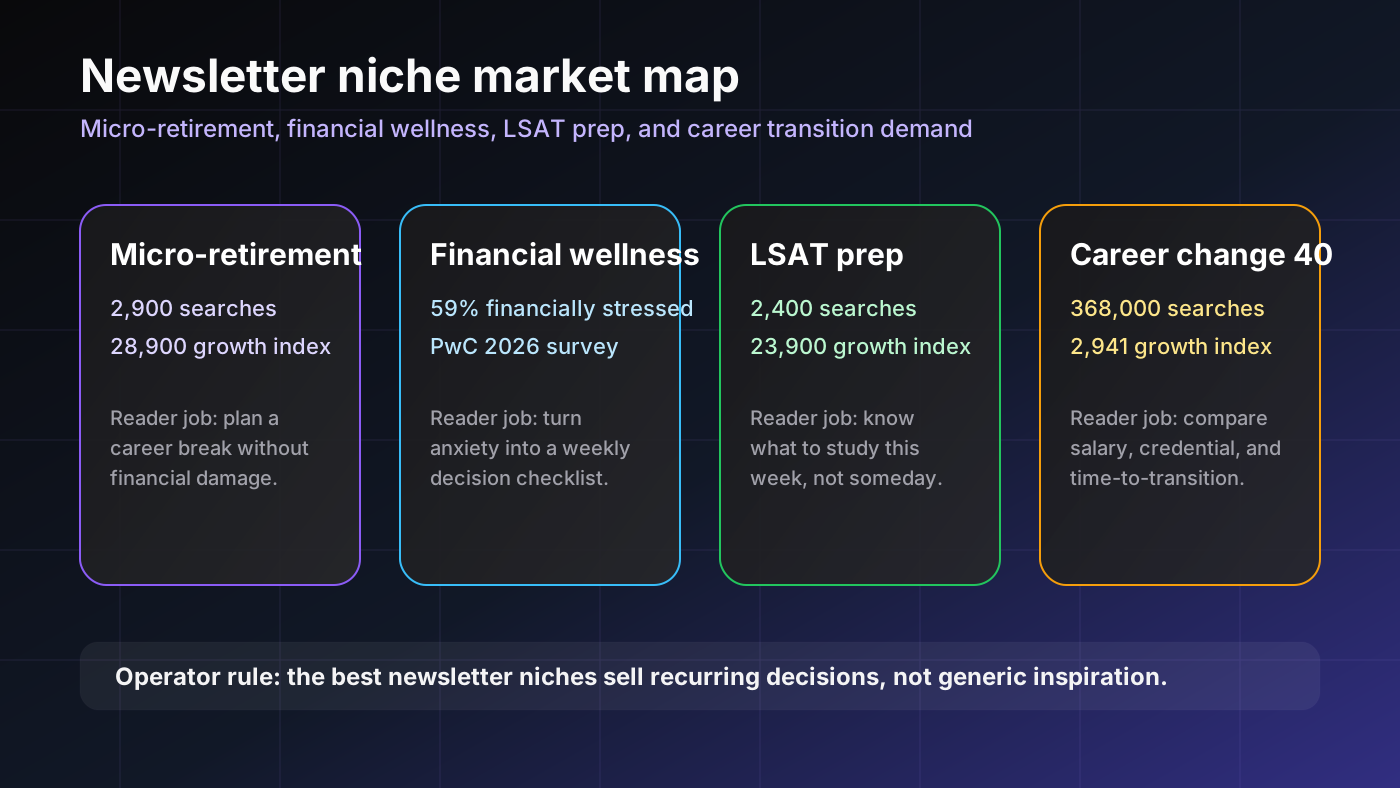
The Market Signal: Newsletter Platforms Are Rewarding Narrow Expertise
Newsletter demand is not just a creator-economy story. It is a buyer-behavior story. WebProNews, summarizing Reuters beehiiv figures reported that beehiiv expects annual revenue to nearly double to $50 million in 2026, with more than 130,000 publishers, 40,000 monthly active users, nearly 15,000 paying subscribers, and a $225 million valuation. beehiiv's own 2026 report says paid subscriptions generated $19 million in 2025, up from $8 million in 2024, a 138% jump.
The operator implication is blunt: generalized newsletters are fighting an inbox war. Specialized newsletters that solve recurring decisions can still earn. Micro-retirement qualifies because the decision is financially specific. The reader is not asking for motivation. They are asking whether they can take four months off, how much cash they need, whether they should return to the same employer, and what benefits or side income keep the plan from becoming reckless.
| Source | 2026 signal | Why it matters for newsletter niches |
|---|---|---|
| WebProNews on beehiiv | $50 million expected annual revenue | Newsletter infrastructure has enough platform-level demand to support niche operators |
| beehiiv State of Newsletters | 28 billion emails sent, 255 million unique readers | Email is still a scaled distribution channel, not a nostalgia format |
| beehiiv State of Newsletters | $19 million in paid subscriptions, up 138% | Paid content is working best where expertise is specialized |
| WebProNews on beehiiv | Substack has 5 million paid subscriptions | Reader willingness to pay for independent expertise is already proven |
This is why Newsletter Niches should not be chosen by audience size alone. Search volume finds curiosity. Paid conversion usually comes from consequence. A reader planning a career break faces cash-flow risk, health insurance risk, resume risk, and relationship risk with an employer. Those risks support paid checklists, calculators, expert interviews, cohort calls, and eventually a SaaS workflow.
Key insight: the right newsletter niche is not the one with the largest audience. It is the one where a reader has a recurring decision, a financial consequence, and no trusted operating manual.
The Category Zoom: Micro-Retirement Is a Financial Wellness Niche, Not a Vacation Niche
The external data points in the same direction. Forbes cited a SideHustles.com survey of 1,000 American workers showing that one in 10 intended to take a micro-retirement in 2025, respondents expected an average four-month break, and prospective micro-retirees intended to save around $15,000 before leaving work. Employee Benefit News reported that 75% of employees want formal micro-retirement policies, with 13% of millennials and nearly 10% of Gen Zers planning one.
That converts the newsletter idea from soft lifestyle content into a compliance, benefits, and planning lane. Employers need policy templates. Employees need affordability models. Financial advisors need segment-specific education funnels. HR teams need documentation standards so a career pause does not create knowledge loss or inconsistent leave decisions.
The MNB database shows adjacent demand in niches that already score well:
Score table locked in the signed-in dossier.
The relevant MNB metric here is MNDS, Market Need + Demand Signal. A micro-retirement newsletter has a strong MNDS because the keyword is growing fast and the buyer pain is practical. NVS, the Niche Viability Score, should be judged through the same lens: can the content graduate into a paid product, a calculator, an advisory workflow, or a benefits-policy kit?
There is also a timing driver. While micro-retirement is not governed by a single federal deadline, paid family leave, unpaid sabbaticals, benefits continuation, ACA enrollment windows, and employer leave policies create hard operational boundaries. A newsletter that publishes "how to pitch a four-month leave" without health insurance, documentation, and re-entry planning is entertainment. A newsletter that turns those constraints into templates is a business.
Internal sibling read: compare this with the earlier personal finance newsletter niches analysis, then use the current keyword growth table below to decide whether micro-retirement deserves its own vertical.
The Data Zoom: The Best Newsletter Niches Have Search Demand Plus a Repeatable Decision
Micro-retirement is the sharpest signal, but it is not the only newsletter candidate in today's keyword feed. LSAT prep resources posted 2,400 monthly searches with a 23,900 growth index. Career change at 40 posted 368,000 monthly searches with a 2,941 growth index. Personal finance app posted 201,000 monthly searches with a 4,468 growth index. Power of attorney lawyers posted 27,100 monthly searches with a 1,029 growth index.
Those are not interchangeable. The MNB scoring lens separates audience curiosity from workflow ownership. WSOR, Workflow Standardization + Ownership Ratio, asks whether one buyer owns a repeatable workflow. LSAT prep has a clear weekly study workflow. Power of attorney content has a clear document-preparation workflow. Career change at 40 is broader, so the newsletter must narrow by persona or outcome. MTRI, Market Timing + Readiness Index, asks whether the market is primed now. Micro-retirement scores well on MTRI because media coverage, employee demand, and financial stress are moving at the same time.
| Keyword | Search volume | Growth index | Current difficulty | Newsletter wedge |
|---|---|---|---|---|
| Micro retirement | 2,900 | 28,900 | Not populated | Paid planning newsletter for career breaks and sabbaticals |
| LSAT prep resources | 2,400 | 23,900 | Not populated | Weekly study plan, admissions calendar, and test strategy brief |
| Personal finance app | 201,000 | 4,468 | Not populated | App comparison newsletter for budgeting, saving, and habit loops |
| Career change at 40 | 368,000 | 2,941 | Not populated | Mid-career transition brief by industry and credential path |
| Power of attorney lawyers | 27,100 | 1,029 | Not populated | Family legal planning newsletter with attorney referral funnel |
External demand supports the financial-wellness angle. PwC's 2026 Employee Financial Wellness Survey surveyed nearly 3,500 employees and found 59% are stressed about finances, 53% have less than $5,000 saved for emergencies, and 30% have less than $1,000. EBRI and Greenwald Research found only 64% of Americans feel confident they will have enough money to live comfortably in retirement, with worker confidence down 6 percentage points from 2025.
Those numbers make micro-retirement harder, not less attractive. The pain is not simply "I want time off." It is "I want time off while debt, savings, health costs, and employer benefits are unstable." That is a paid content market if the operator can provide trustworthy numbers and repeatable planning artifacts.
The Opportunity Playbook: Four Buyer Lanes Worth Testing
-
HR benefits leader: micro-retirement policy brief. Sell a monthly policy memo to CHROs, benefits directors, and people operations leaders. Deliverables: sabbatical policy templates, manager approval checklists, knowledge-transfer workflows, re-entry plans, and employee communication copy. Competes with generic HR content from SHRM-style libraries, but wins by focusing on micro-retirement as a retention mechanic.
-
Financial advisor: career-break planning funnel. Sell to CFPs and financial coaches who want a content product for younger professionals. Deliverables: $15,000 savings-plan calculators, health-insurance decision trees, side-income planning worksheets, and referral-ready newsletter issues. Sells against generic personal finance newsletters by focusing on a named event with a date and budget.
-
Mid-career professional: paid decision newsletter. Sell directly to workers aged 30 to 45 who are planning a break, career pivot, or delayed burnout recovery. Deliverables: weekly affordability checklists, sample employer pitch scripts, state-by-state benefits notes, and re-entry planning guides. Competes with Substack lifestyle essays, but the product must feel closer to NerdWallet or The Points Guy in utility.
-
Education operator: LSAT and career-switch bundle. Use the LSAT prep signal as a separate or adjacent paid newsletter for career switchers considering law school. LSAC reported 2025 applicants up 18%, early 2026 applicants up 33%, and applications up 27% at the same point in the cycle. Deliverables: weekly LSAT plan, admissions deadline tracker, scholarship checklist, and school selection scorecard. Competes with 7Sage, Blueprint, and Khan Academy's free LSAT resources, but can win on accountability and admissions timing.
-
Employer financial wellness vendor: segmented employee education. Sell a white-label newsletter module to benefits consultants and financial wellness vendors. Deliverables: micro-retirement explainers, emergency-savings nudges, retirement-leakage warnings, and manager FAQs. Morgan Stanley at Work found 84% of employees encountered financial issues in the past year and 95% consider access to professional financial planners important when choosing where to work. That gives vendors a clear ROI story.
The simplest test is not a full media brand. Launch one landing page, one sample calculator, and four issues: affordability, employer pitch, health insurance, and re-entry plan. If paid conversion is weak, the idea probably belongs as a lead magnet for advisors or HR vendors rather than as a standalone paid newsletter.
FAQ
What's the simplest version someone could build?
A four-week micro-retirement planning brief: cash target, employer pitch, benefits checklist, and return-to-work plan. The MNB signal is strong because "Micro retirement" shows 2,900 monthly searches and a 28,900 growth index, while Forbes reported prospective micro-retirees planned to save around $15,000 before taking a break.
Is this better as a newsletter or a SaaS product?
Start as a newsletter, then productize the worksheet that readers reuse. The closest MNB comparison is "Finance app that builds money habits in three minutes a day," which score locked. That score implies behavior-change workflows can work when the action is small, recurring, and measurable.
Who pays first: employees, advisors, or employers?
Employees validate the pain fastest, but advisors and employers likely produce better contract value. PwC found 59% of employees are financially stressed, and Morgan Stanley at Work found 95% consider access to financial planners important when choosing where to work. That points to B2B distribution after direct-reader proof.
The Bottom Line
Micro-retirement is not a feel-good newsletter niche. It is a financial decision-support niche hiding inside a lifestyle phrase. The proof point is the combination of 2,900 monthly searches, a 28,900 growth index, 59% employee financial stress from PwC, and a $50 million 2026 revenue target for beehiiv. If you are evaluating this category, build one paid issue around the $15,000 career-break budget and track whether readers click the calculator before they click the essay.
Every niche score on MicroNicheBrowser uses data from 11 live platforms. See our scoring methodology
Related Articles
Septic Service Micro-SaaS Ideas: 135,000 Monthly Searches Point to a Boring $8.1B Workflow Gap
A $8.1B septic services market, 135,000 monthly searches, and an MNB rating of 74 make route-density software the sharp Monday Micro-SaaS wedge.
ReadAI Jobs Impact Weekly: Goldman's 16,000-Job Drag Points to Governance Micro-SaaS
Goldman Sachs says AI reduced U.S. payroll growth by roughly 16,000 jobs per month. The operator opportunity is governance workflow software.
ReadE-commerce Sub-Niches 2026: 21 MNB Signals Point to Rural Home Maintenance Commerce
U.S. e-commerce hit $326.7B in Q1 2026, but the best MNB signals point to septic, senior safety, and workflow commerce.
Read